
QCTO guide
Understanding the Quality Council for Trades and Occupations
A plain-language guide to the QCTO framework, its processes and what it means for your organisation and your career.
What is the QCTO?The NQFThe transitionOccupational qualificationsFISA & EISASETAsLearnershipsWhat to do now
The basics
What is the QCTO?
The Quality Council for Trades and Occupations (QCTO) is a statutory body established under the Skills Development Act, 1998 (Act 97 of 1998). It is one of three Quality Councils in South Africa’s National Qualifications Framework (NQF), alongside Umalusi and the Council on Higher Education (CHE).
Its mandate is to develop, maintain and quality-assure the occupational qualifications and part-qualifications on the Occupational Qualifications Sub-Framework (OQSF). Put simply, the QCTO makes sure that what people learn in occupational training matches what employers need.
The QCTO falls under the Department of Higher Education and Training and works with industry bodies, employers, training providers and SETAs to keep qualifications relevant, credible and nationally recognised.

Why it matters
Real, measurable, industry-relevant skills
South Africa needs a workforce with skills that employers can rely on. The QCTO sets and enforces the standard for occupational training — so whether you are an employer investing in your workforce, an individual building a career or a training provider, the framework shapes the qualifications you pursue, the assessments you write and the credentials you earn.
The National Qualifications Framework
Three sub-frameworks, ten levels
The NQF classifies every South African qualification on ten levels, from basic literacy (Level 1) to doctoral degrees (Level 10). It is organised into three sub-frameworks, each with its own Quality Council:
OQSF — QCTO
The Occupational Qualifications Sub-Framework covers trades, occupations and professions at NQF Levels 1 to 8.
GFETQSF — Umalusi
The General and Further Education and Training Qualifications Sub-Framework covers schooling and adult education at NQF Levels 1 to 4.
HEQSF — CHE
The Higher Education Qualifications Sub-Framework covers higher certificates to doctorates at NQF Levels 5 to 10.
The QCTO transition
From legacy qualifications to occupational qualifications
For years, vocational training relied on “legacy” qualifications — unit-standard-based credentials registered before 2009. Employers found that many graduates had theoretical knowledge but lacked the practical, integrated competence the workplace needs.
The QCTO’s response is to phase out legacy qualifications and replace them with a new generation of occupational qualifications. Transitional arrangements apply to some programmes, including certain pre-2009 and NATED programmes, depending on sector readiness and learner impact.
Key dates to plan for
- 15 June 2026 — full list of affected qualifications published in the Government Gazette
- 30 June 2026 — no new enrolments on legacy qualifications
- 31 December 2027 — final completion date for learners already enrolled on legacy programmes
Deadlines are set by the QCTO and can change. Always check the latest QCTO communication before you plan enrolments.
Occupational qualifications
Three components, one job-ready person
Occupational qualifications are competency-based and industry-aligned: they reflect what people actually do in their jobs, not only what they know. Each one has three integrated components:
Knowledge
The theory the occupation requires, delivered by an accredited skills development provider through structured learning.
Practical skills
Applying the knowledge in a simulated or real workplace, assessed through practical tasks and demonstrations.
Workplace experience
On-the-job learning in a real workplace, verified by a workplace mentor and assessed by a qualified assessor.
Assessment
Internal assessment, then an independent final assessment
Final Integrated Summative Assessment (FISA)
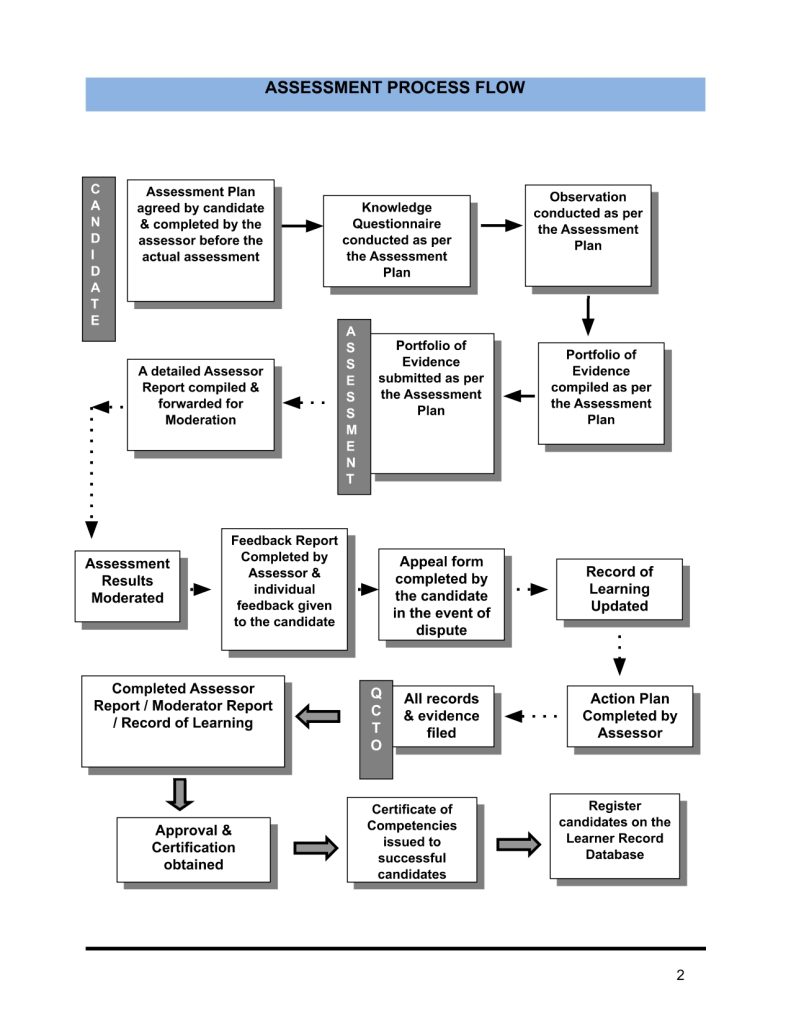
A final, supervised assessment conducted by the accredited training provider under examination conditions — for example at the end of a QCTO skills programme. For full occupational qualifications, the provider’s internal assessments confirm that the learner is ready for the external assessment.
External Integrated Summative Assessment (EISA)
The final, high-stakes assessment for an occupational qualification. It is conducted independently of the training provider, at a QCTO-accredited assessment centre and under the QCTO’s quality assurance. Because the assessor is independent, the qualification is credible and consistent nationally.
SETAs
The evolving role of SETAs
Under the new framework, qualification development and quality assurance sit with the QCTO. Sector Education and Training Authorities remain essential, and employers and providers should work with both.
- Sector skills planning — identifying the skills each industry needs
- Learnership funding — administering funding for workplace-based learning
- Workplace approval — approving workplaces for practical and workplace components
- Employer grants — administering mandatory and discretionary grants
Learnerships
Learnerships under the QCTO framework
A learnership is a structured, workplace-based programme that combines theoretical learning with on-the-job experience and leads to a registered qualification. Learnerships are being aligned to the new occupational qualifications.
For employers
- Tax incentive — registered learnerships may qualify for the Section 12H learnership allowance; confirm current rules with your tax adviser
- B-BBEE points — learnerships contribute to the Skills Development element of your scorecard
- SETA grants — qualifying employers can access mandatory and discretionary grants
- Workforce development — a skilled, qualified team aligned to your operational needs
For learners
- A nationally recognised qualification on the NQF
- Real workplace experience, not just a classroom certificate
- A monthly stipend during the learnership
- Better employment prospects with a qualification employers recognise
For employers
What to do now
- Review your training portfolio. Check whether active programmes are legacy qualifications and confirm completion timelines for enrolled learners.
- Confirm your SETA registration. Make sure your workplace approval and SETA registration are current and aligned with QCTO requirements.
- Plan for the EISA. Build external assessment scheduling and costs into your training timelines and budgets from the start.
- Align new enrolments. Enrol new learnerships and training on QCTO-registered occupational qualifications and skills programmes.
- Work with an experienced partner. An accredited, experienced provider saves time, cost and compliance risk.
Why organisations choose Tonex
We know the QCTO framework inside out
10+ years in skills development
From accreditation requirements and learnership design to assessment planning and compliance documentation, we partner with organisations to build compliant, effective and future-ready workforce development strategies.
Tell us what you need. We’ll build the programme around it.
Training five or more people? Ask about on-site delivery and learnership funding options.