
- 5 Sections
- 15 Lessons
- 4 Quizzes
- 1 Assignment
- 20h Duration
Knowledge Module
Pre-course assessment
Application Module
Final Assessments
Post-course assessment
About the Skills Programme
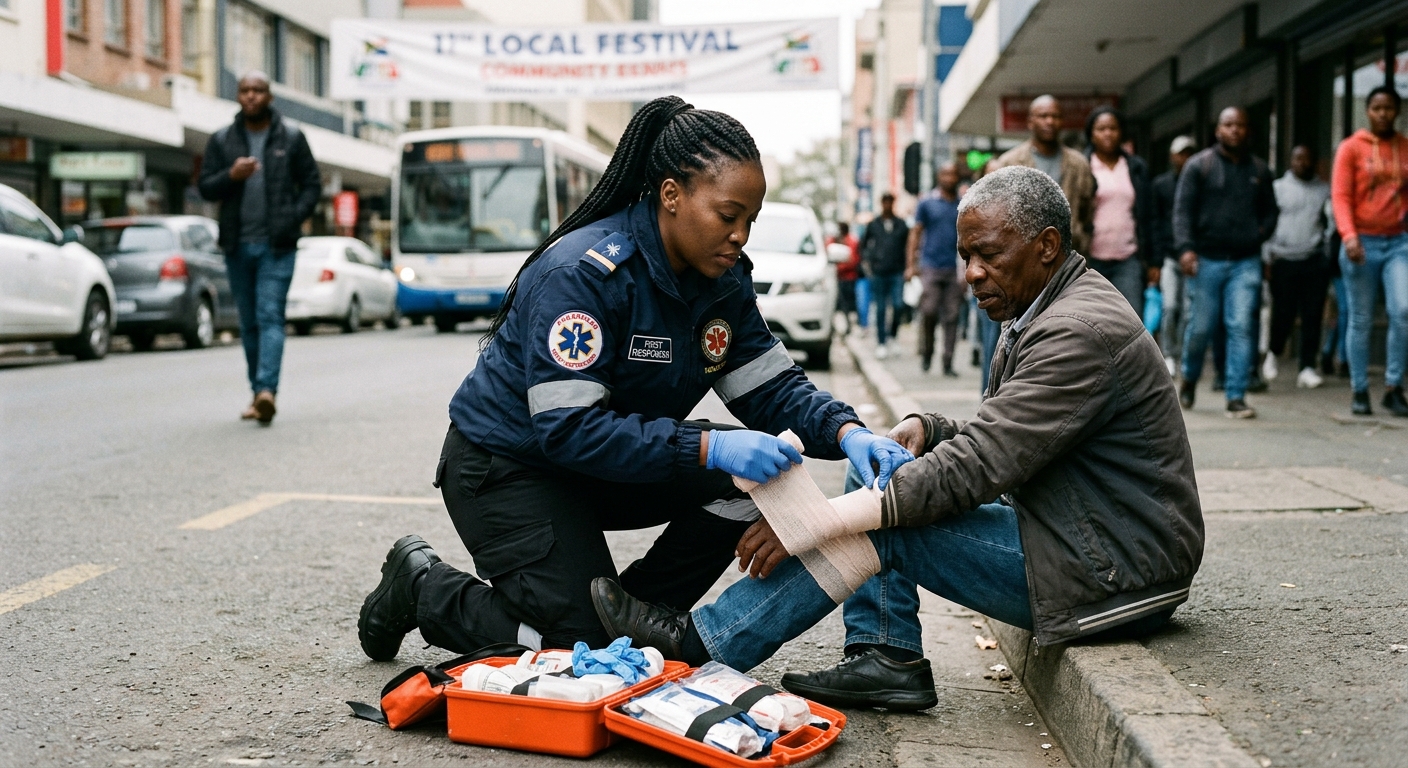
The Skills Programme: Basic Emergency First Aid Responder (SP-230801) is a QCTO-aligned programme that prepares learners to act competently in the minutes between an emergency happening and professional help arriving. The programme responds directly to South Africa's requirement for trained first aiders in the workplace, and it equips learners to make a scene safe, assess a casualty, summon help, and perform the interventions that keep someone alive until an ambulance arrives.
The programme integrates knowledge with hands-on practical work across the full first aid response — from the legal and ethical principles of assisting a casualty, through basic anatomy and physiology, to recognising and treating emergencies, injuries and illnesses. On completion, learners are able to approach and make safe an incident scene, protect themselves with appropriate equipment, conduct a primary assessment and summon emergency services, perform adult CPR and use an automated external defibrillator, place an unresponsive breathing casualty in the recovery position, control severe bleeding and manage shock, conduct a secondary assessment, and hand over to emergency services with a complete incident record.
Purpose
The purpose of this skills programme is to prepare a learner to provide basic emergency first aid to a casualty until professional medical help takes over. The role has firm limits, and understanding those limits is as much part of the competence as the skills themselves. Three rules never change: your own safety comes first, because you cannot help anybody if you become the second casualty; call for help early, on 10177 or 112 from any mobile, as soon as you know you need it; and work within your scope — a basic first aid responder does not diagnose, does not give medicines, and does not attempt clinical procedures.
Who Should Enrol?
This programme is designed for anyone who may be first on the scene when someone is injured or collapses at work. It is well suited to:
- Appointed workplace first aiders and health and safety representatives.
- Supervisors, team leaders and shift leaders responsible for people on site.
- Reception, security and front-of-house staff who deal with the public.
- Drivers, field staff and lone workers operating away from immediate help.
- Employers meeting their first aid obligations under the Occupational Health and Safety Act, and community organisations, schools, sports clubs and places of worship building emergency capability.
Entry Requirements
There are no formal entry requirements beyond the ability to read, write and communicate in English at NQF Level 1, and the physical ability to kneel beside a casualty and perform chest compressions. Learners with a physical condition that would make compressions or kneeling difficult should tell the facilitator before the practical session so that reasonable accommodation can be arranged where possible. Recognition of Prior Learning is available in accordance with the QCTO RPL Policy and must be applied for before the programme commences; learners holding a current first aid certificate from another provider are often strong RPL candidates for parts of KT03.
Career Opportunities
This is a workplace safety credential rather than a career qualification on its own, but it opens and strengthens a number of roles:
- Appointed workplace first aider — a designated position most employers must fill.
- Health and safety representative or committee member.
- Security, reception or facilities staff with emergency response duties.
- Community, school, sports club or event first aid volunteer.
- Foundation for further study toward higher-level first aid and emergency care qualifications.
Want to submit a review? Login and enrolled
This course includes
Approach and make safe an incident scene
Protect yourself with the right equipment
Assess a casualty and call emergency services
Perform adult CPR and use an AED
Place an unresponsive breathing casualty in recovery position
Control severe bleeding and manage shock
Conduct a secondary assessment and hand over properly
Complete an accurate incident record